
In Search of Eco-Spiritual Artistic Modernism. “Socialist Eco-Aesthetics” Writing Workshop at TU-Dresden
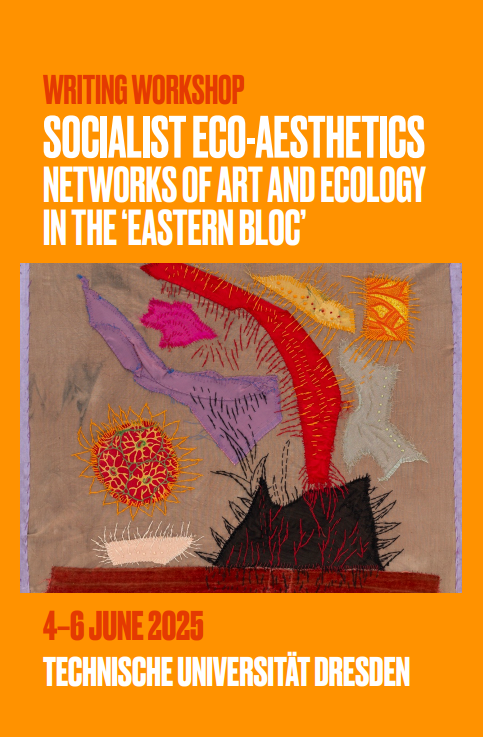
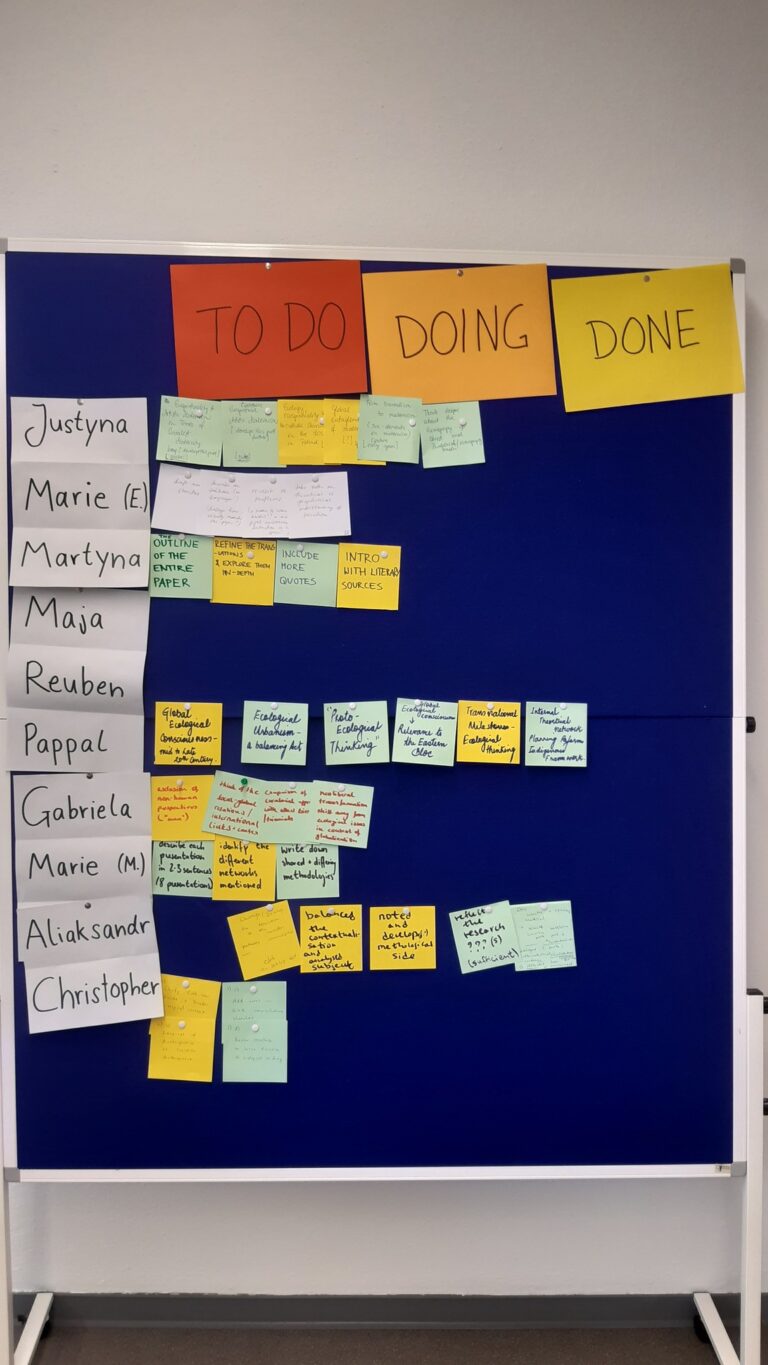
From June 4 to June 6, the Technische Universität in Dresden hosted the Writing Workshop “Socialist Eco-aesthetics: Networks of Art and Ecology in the ‘Eastern Bloc’” . The event was accompanied by a joint seminar and a guest lecture by Maja and Reuben Fowkes, titled “Green Border Crossings: Beyond-Human Agents in the Eco-Critical Art Practice of the Socialist Anthropocene”.
In her presentation, Justyna focused on the analysis of selected texts and paintings by Jerzy Ćwiertnia (1928–2009) created during the era of the Polish People’s Republic, in which spirituality—particularly of Eastern origin—intertwines with a deep concern for the fate of non-human beings. Its primary aim was to reconstruct Ćwiertnia’s theory of art, shaped by Hindu and Buddhist philosophy, and to define the alternative form of artistic modernism the artist pursued throughout his life. The main analytical framework for interpreting both his theoretical writings and artistic practice was the relatively recent field of humanities research known as ecological spirituality, or eco-spirituality.
Ćwiertnia’s creative stance and its ideological foundations were further examined in the context of the complex relationships between socialist modernity, spirituality, and ecology. Ćwiertnia’s continual balancing between abstraction and figuration, along with his engagement with iconography derived from what he perceived as the ecologically harmful legacy of Christianity, was presented as his ongoing confrontation with the Lacanian Real – suffering inherent in the lives of all sentient beings. It turns out that what ultimately comes to the fore in Ćwiertnia’s painting — in line with Didi-Huberman’s theology of the image — is desire (which, incidentally, is also the title of Ćwiertnia’s renowned 1955 work); yet it is a desire rooted in ethical and spiritual needs, which the artist contrasts with material desire through his Marxist critique of Western commodity culture.
Finally, Ćwiertnia’s example clearly demonstrates that Far Eastern religions and their associated ideas—including ecological ones—were not solely the result of the transmission and adaptation of phenomena from the Western counterculture of the 1970s, but also drew on earlier, local sources and culturally and politically embedded points of encounter.
Gallery

![Hilary Krzysztofiak, Red figure hanging from a cross [Czerwona postać zawieszona na krzyżu], 1969, oil, cardboard on panel, 100 x 65 cm, photo by Piotr Kurek © Fundacja Hilarego Krzysztofiaka/Hilary Krzysztofiak Foundation](https://alternative-spirituality-in-art.ihs.uw.edu.pl/wp-content/uploads/2025/02/700px-x-600px-–-5.jpg)
